
Every growing MSP eventually faces the same decision: when ticket volume outgrows your current team, do you hire another technician or outsource to an offshore helpdesk? The answer determines not just your cost structure, but how fast you can scale, how well you sleep during after-hours incidents, and how much margin you keep on every managed seat.
Most comparisons you’ll find online are vague. This one isn’t. Below is a realistic, line-by-line cost comparison between building an in-house helpdesk team and partnering with an offshore IT helpdesk — using real US market numbers for 2026.
The True Cost of an In-House Helpdesk Team

The salary is only the beginning. When MSP owners calculate the cost of an in-house technician, they usually stop at base pay — and underestimate their real cost by 40% or more. Here’s the full picture for a single L1/L2 technician in the US:
- Base salary: $55,000–$75,000/year depending on market. IT labor shortages continue to push this upward every year.
- Payroll taxes & benefits: Add 25–30% on top of base — health insurance, 401(k) match, FICA, unemployment insurance. That’s another $14,000–$22,000.
- Recruiting costs: Job board fees, recruiter commissions (15–20% of first-year salary if you use one), and the internal hours spent screening candidates: $8,000–$15,000 per hire.
- Onboarding & training: A new tech takes 3–6 months to reach full productivity. During that ramp, you’re paying full salary for partial output — a hidden cost of $10,000+.
- Tools & overhead: Workstation, licenses, office space (or remote stipend), management time: $3,000–$6,000/year.
- Turnover risk: IT helpdesk turnover runs 30–40% annually. When a trained tech leaves after 18 months, you restart the entire cycle — recruiting, onboarding, ramp time — while tickets pile up.
Realistic total: $90,000–$120,000 per technician per year, once everything is counted. And that buys you coverage for one shift, five days a week. If you need true 24/7 coverage, multiply by three to four technicians minimum — pushing past $300,000 annually before you’ve covered a single weekend.
What an Offshore Helpdesk Actually Costs
An offshore helpdesk partner charges a flat monthly rate per dedicated technician or per seat/ticket volume, typically landing between $15–$25/hour equivalent. A dedicated full-time offshore L1/L2 technician typically costs around 60% less than the equivalent loaded in-house cost, with the exact figure scoped to your ticket volume and coverage hours.
Critically, that number is all-inclusive. With a mature outsourced helpdesk service, the provider absorbs:
- Recruiting and vetting — they maintain the talent pipeline, not you
- Training — technicians arrive already trained on PSA/RMM platforms, ticketing workflows, and MSP service standards
- Management and QA — team leads, quality reviews, and SLA monitoring are built into the rate
- Turnover — if a technician leaves, the provider replaces them at no cost to you, with knowledge transfer handled internally
- Infrastructure — workstations, connectivity, and security compliance are the provider’s responsibility
For 24/7 coverage, offshore economics get even better. Because providers run follow-the-sun shift models across their existing workforce, adding night and weekend coverage costs a fraction of what triple-shift US staffing would. Many MSPs get full 24/7 remote IT support for less than the cost of one US technician.
Side-by-Side: The Numbers That Matter
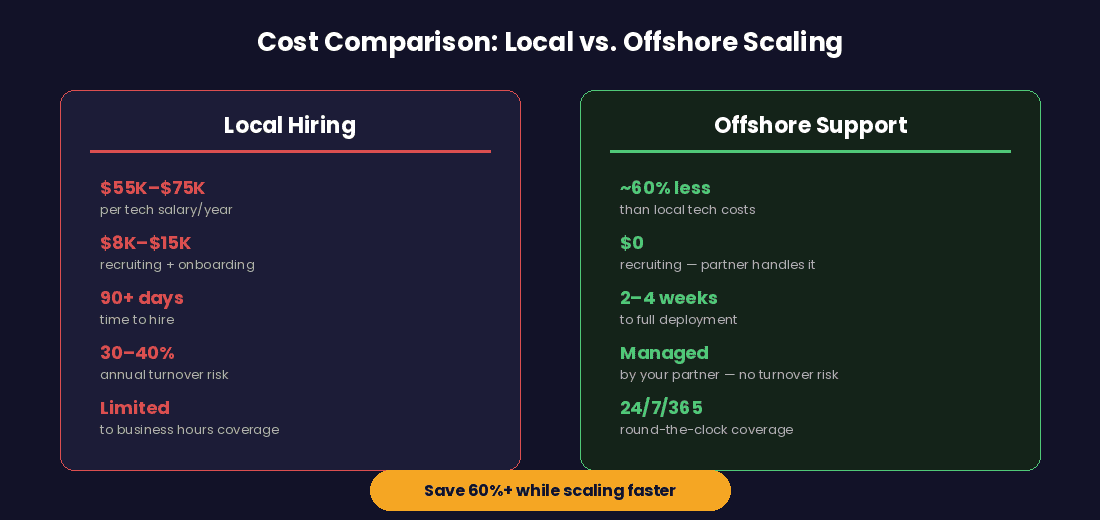
Here’s the direct comparison for a typical growing MSP that needs two full-time equivalent technicians:
| Cost Factor | In-House (2 techs) | Offshore (2 dedicated techs) |
|---|---|---|
| Annual base cost | $110,000–$150,000 | ~60% less, all-in |
| Benefits & payroll taxes | $28,000–$44,000 | Included |
| Recruiting & onboarding | $16,000–$30,000 | $0 |
| Management overhead | $10,000+ | Included |
| Turnover replacement risk | High — you carry it | Provider carries it |
| Time to productive | 90+ days per hire | 2–4 weeks |
| After-hours coverage | Not included | Available at marginal cost |
| Realistic annual total | $180,000–$240,000 | ~60% less |
The math consistently lands in the same place: offshore support costs 55–65% less than the equivalent in-house team — which is why “60% savings” has become the standard benchmark MSPs use when evaluating providers.
Beyond Cost: What Else Changes When You Go Offshore
Cost is the headline, but experienced MSP operators weigh four other factors that often matter more over a three-year horizon.
Scalability on demand
Winning a new 200-seat client with an in-house model means a hiring scramble: 90+ days to find a tech, months more to train them. With an offshore partner, you request additional capacity and it’s live within weeks. Growth stops being gated by your local labor market.
Coverage without burnout
The silent killer of small MSP teams is after-hours rotation. On-call duty burns out your best engineers and pushes them toward employers who don’t require it. Offloading nights and weekends to an offshore service desk protects both your SLAs and your core team’s sanity.
Consistency through documentation
Good offshore providers force operational maturity: documented SOPs, runbooks, and escalation paths. Many MSPs report that the discipline of preparing for outsourcing improved their internal operations more than any tool purchase.
White-label brand protection
A common fear — “my clients will know” — rarely survives contact with reality. A proper white label IT support arrangement means technicians answer with your company name, use your email domain, work inside your PSA, and follow your communication standards. Your clients experience your brand, delivered by an extended team.
When In-House Still Makes Sense
Honesty matters here: offshore isn’t the right answer for every role. Keep these in-house:
- Client-facing account management — relationships and QBRs belong with your local team
- Complex project work — on-site migrations, physical infrastructure, and hands-on deployments need local presence
- vCIO and strategy — high-trust advisory work is your differentiation; don’t outsource it
- Escalation ownership — a senior in-house engineer as the final escalation point keeps quality accountability inside your walls
The pattern that works: outsource the volume, keep the value. L1 password resets, printer tickets, monitoring alerts, and routine NOC operations go offshore. Strategic, physical, and relationship work stays home.
The Hybrid Model: How Most Successful MSPs Actually Do It

The binary “in-house vs. offshore” framing is a false choice. The MSPs scaling fastest in 2026 run hybrid teams:
- Offshore L1/L2 handles 70–80% of ticket volume — the repetitive, well-documented work
- In-house senior engineers own escalations, projects, and client relationships
- Offshore NOC watches infrastructure 24/7, waking your on-call engineer only for true emergencies
- Gradual expansion — most start with after-hours or overflow coverage, then expand scope as trust builds
This structure typically cuts total support costs 40–50% while improving response times — because tickets get answered around the clock instead of waiting for morning.
How to Run the Numbers for Your Own MSP
Ready to compare for your specific situation? Use this quick framework:
- Calculate your true in-house cost per tech: base salary × 1.4 (the loaded-cost multiplier covering benefits, taxes, and overhead)
- Audit your ticket mix: what percentage is L1/L2 work that follows documented procedures? That’s your outsourceable volume.
- Price the offshore equivalent: request quotes for dedicated technicians covering that volume — expect roughly 60% of your loaded in-house cost per FTE
- Factor the growth question: if you won two new clients next quarter, which model lets you absorb them without a hiring panic?
For most MSPs above 300 endpoints, the comparison isn’t close. The savings fund growth: new sales hires, better tooling, or simply healthier margins per seat.
Frequently Asked Questions
How much cheaper is an offshore helpdesk compared to in-house staff?
Offshore helpdesk support typically costs 55–65% less than equivalent in-house staffing once you account for the full loaded cost of US employees — salary, benefits, payroll taxes, recruiting, training, and turnover. A dedicated offshore technician runs roughly 60% less than the $90,000–$120,000 fully loaded cost of an in-house equivalent, all-inclusive and scoped to your volume.
Will my clients know I’m using an offshore helpdesk?
Not with a white-label arrangement. Offshore technicians work under your brand — your company name, your email domain, your PSA, your ticketing workflows, and your communication standards. From the client’s perspective, they’re simply talking to your support team.
What should MSPs keep in-house when outsourcing support?
Keep client-facing account management, complex project work, vCIO/strategic advisory, and final escalation ownership in-house. Outsource high-volume, well-documented work: L1/L2 tickets, after-hours coverage, and routine NOC monitoring.
How long does it take to transition to an offshore helpdesk?
Most MSPs are fully operational with an offshore team in 2–4 weeks, compared to 90+ days to recruit and onboard a single local hire. The transition involves documenting SOPs, granting PSA/RMM access, and running a short pilot phase — usually starting with after-hours or overflow tickets.
Does offshore support work with ConnectWise, Autotask, and other PSA tools?
Yes. Established offshore providers train technicians on the major MSP platforms — ConnectWise Manage, Datto Autotask, Halo PSA, NinjaRMM, Kaseya, and Microsoft 365 administration. They work inside your existing stack rather than forcing you onto new tools.
Ready to see the numbers for your MSP? Technofied provides dedicated offshore helpdesk, NOC, and service desk teams exclusively for US-based MSPs — white-labeled, PSA-native, and operational in under two weeks. Book a free consultation and we’ll build a side-by-side cost comparison for your exact ticket volume.